
Our research agenda spans from developing intelligent systems to designing and implementing measures to ensure societal acceptance of systems.
Develop intelligent systems
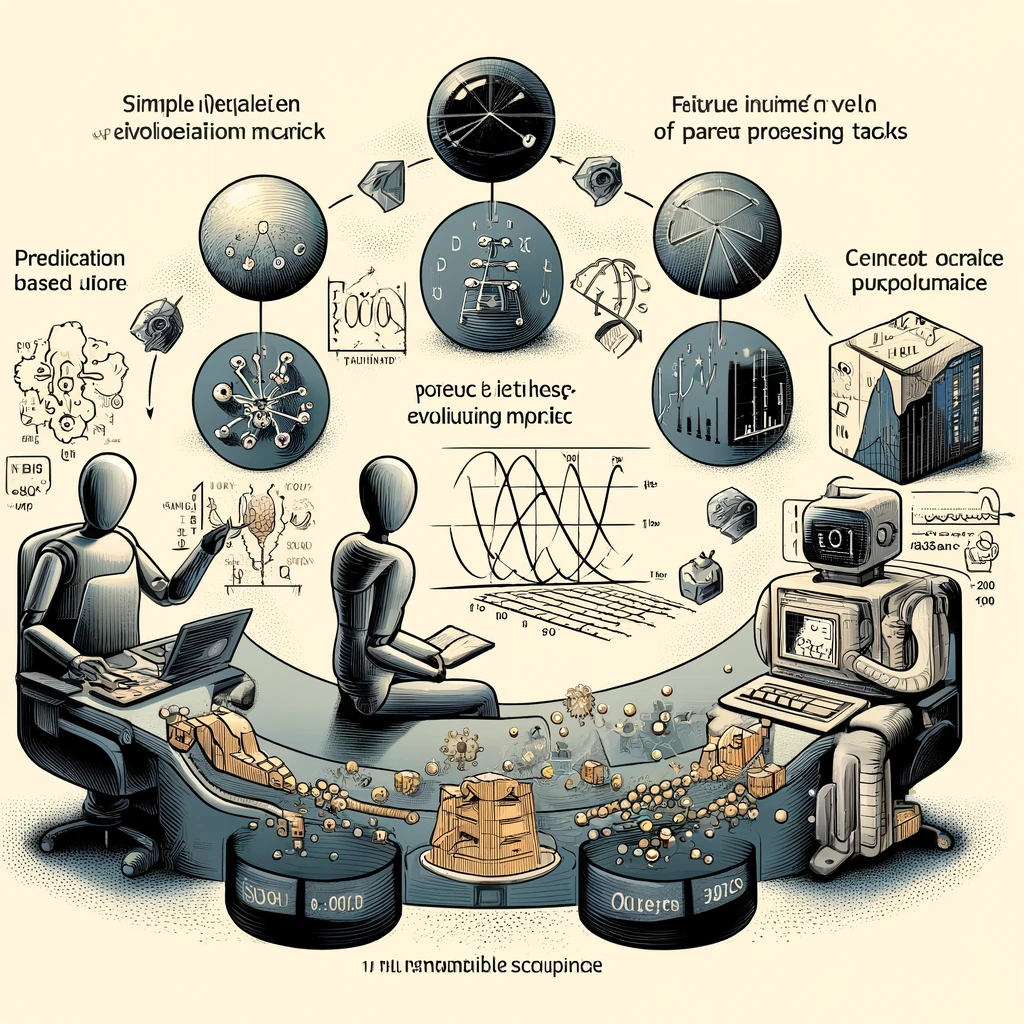
As the complexity of information processing tasks increases, the criteria for evaluation become more varied. For basic arithmetic operations, evaluation is based solely on whether the answer is correct or incorrect. However, when it comes to tasks involving future predictions, while performance can be evaluated probabilistically – such as by accuracy rates – based on past data, it remains unverifiable whether that accuracy rate can be sustained with future inputs until the future arrives. Therefore, intelligent systems may sometimes be difficult to evaluate.
In the field of AI, researchers are working on enhancing the explainability and interpretability of results. Generative AI tasks, which have gained significant attention in recent years, are evaluated based on validity rather than on correct answer rates because there is no single correct answer. When developing new intelligent systems, evaluation criteria should be established concurrently.
Design a framework in which the system is trusted
For a system to be trusted, it must undergo various performance and property verifications. It encompasses the concepts of durability, availability, fault-tolerant, error-tolerant, correctness, reliability, dependability, explainability, responsibility, traceability, dependability, explainability, responsibility, traceability, consistency, integrity, confidentiality, social acceptability, feasibility, possibilities, verifiability, validity, and so on. By properly evaluating these factors and disclosing the results, the system can earn society’s trust.
It is important to ensure that evaluation results are communicated in a way that is understandable to many people. Valid arguments should not be overshadowed by unproven falsehoods. When designing an advanced intelligent system, it is crucial to ensure it can be verified by anyone at any time.

A chiral aperiodic monotile as a motif
The background image is inspired by the shape “Spectres,” discovered by David Smith et al. Spectres are shapes that can fill a plane with only one type of shape, and only in aperiodic fills. It expresses our intention to address a wide variety of issues without resorting to simple repetition.

Members
We open the lab session on Monday evening in the 2026 academic year.
Doctoral students
Motoki Ogata
Baasanjav Uranzaya
Atsuko Utsumi
Hideki Muto
Liu Fan
Feng Xuan Qi
Tetsuya Shiba
Kim Eunmi
Donnet Nefertari
Master’s course students starting before April 2025
Sora Ominato
Miyuto Kitamura
Jin Linqi
Towa Sakurai
Momoko Honda
Makiko Nakajima
Master’s course students starting in September 2025
Kosuke Takatsu
Yanjie Lu
Master’s course students starting in April 2026
Hidenori Takahashi
Keiko Nakamura
Masaru Nagai
Master’s course students starting in September 2026
Anastasios Tsevas
Emma Rose Dodson
Pham Quang Huy
Alumni, Researchers
Yan Ningxin
Shotaro Tanigawa
Tsubasa Kinoshita
Shoji Harata
Yu Hyunmin
Shin Soonnam
Li Jinxuan
Yasuhiro Hayashi
Siregar Josua Aldivio
Jennifer Chia Wu